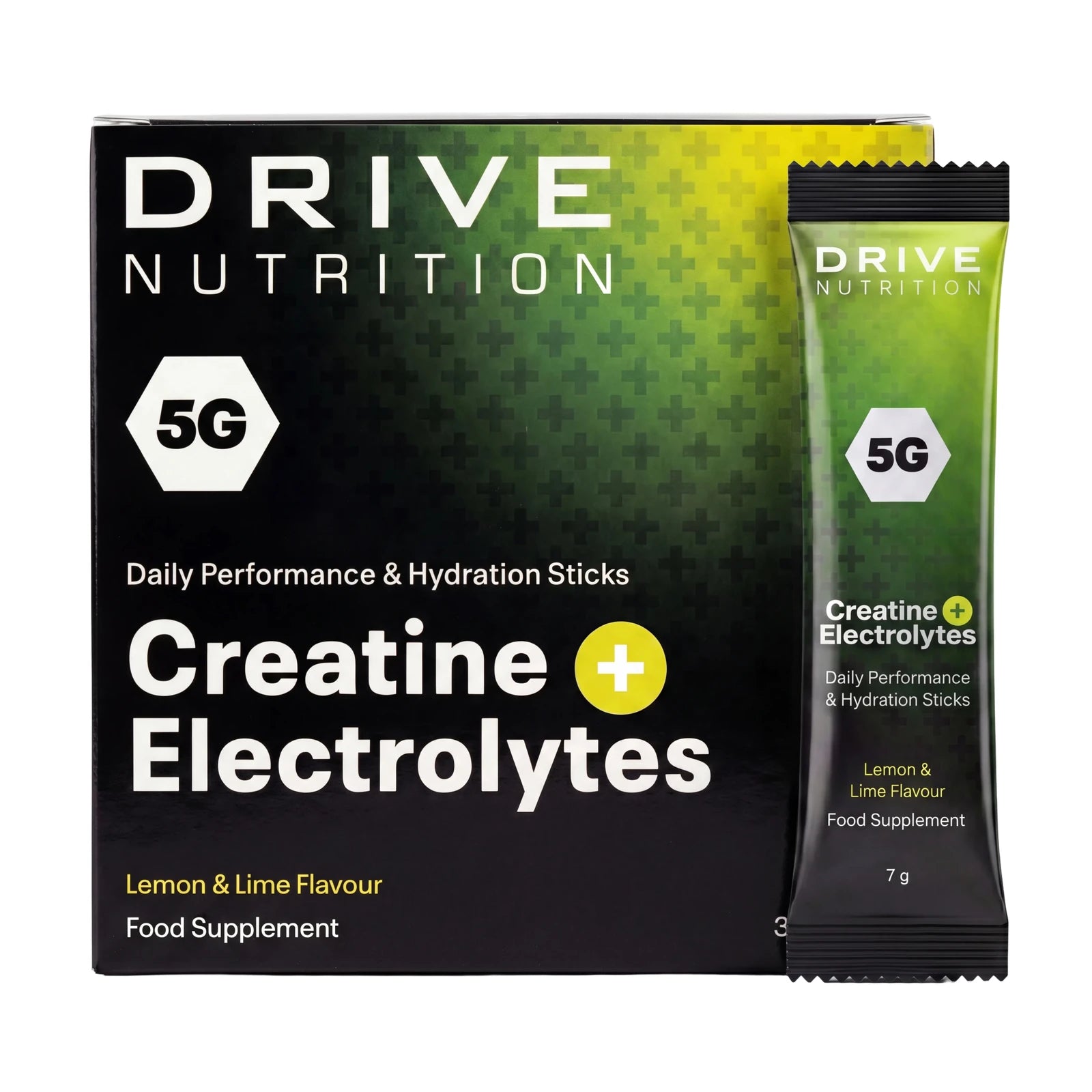
The clinical literature consistently uses 5g. The widely-cited Kreider et al., 2017 position paper and the bulk of saturation-phase studies dose at 5g daily. The 3g level appears in maintenance protocols after saturation, but for someone starting from baseline, 5g reaches phosphocreatine saturation faster and more reliably.
What the research actually shows
Creatine increases physical performance in successive bursts of short-term high-intensity exercise (EFSA-approved claim). The effect is dose-dependent within a window: too little and you under-saturate; too much and you simply lose the excess in urine. 5g sits at the top of that window for most adults.
Why other brands dose at 3g
Two reasons. First, cost — creatine monohydrate is sold by weight, so 3g per serving is meaningfully cheaper than 5g across a 30-serving box. Second, marketing — '3g of clinically proven creatine' is technically defensible against the literature, even if it's the lower bound.
The Drive position
We dose to the research, not to the spreadsheet. If 5g is what's been studied in the strength and recovery trials, that's what we put in the pack. Every milligram on the front of the carton.
Sources
Kreider RB, et al. International Society of Sports Nutrition position stand: safety and efficacy of creatine supplementation in exercise, sport, and medicine. JISSN, 2017.
Buford TW, et al. International Society of Sports Nutrition position stand: creatine supplementation and exercise. JISSN, 2007.